Which parts of a wallet keep your identity private and which ones are theatre? That’s the sharp question many privacy-focused users in the U.S. ask when choosing a wallet for Monero, Bitcoin, Litecoin and other assets. I’ll walk through a realistic case—an everyday power user who needs XMR for private receipts, BTC for mixed on-chain activity, and occasional swaps across chains—and use that scenario to expose the mechanisms, trade-offs, and failure modes that determine real privacy.
The goal is practical: give you a working mental model of how a modern privacy-first, multi-currency wallet combines networking controls, local hardware protections, protocol-level privacy features, and swap routing—and where those layers succeed or break. I use one wallet’s feature set as the anchor for this analysis because it bundles the kinds of technical choices privacy users care about: Tor/I2P routing, device-level encryption, open-source non‑custodial keys, Monero-specific protections, Bitcoin privacy tools, hardware-wallet integration, and decentralized cross-chain swaps.
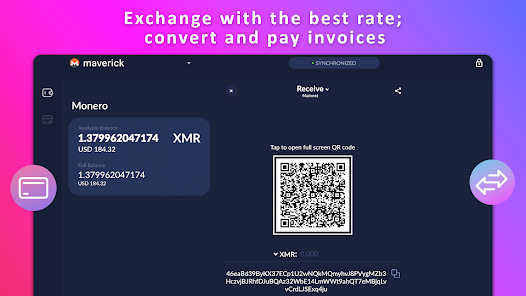
Case: a privacy-conscious U.S. user and their threat model
Our hypothetical user, Sam, receives donations in Monero, pays contractors in Bitcoin occasionally, and sometimes swaps between coins to rebalance holdings. Sam’s threat model is specific but common: avoid address linking and IP-level deanonymization; prevent custody leaks (no third-party holding keys); and keep device compromise and local subpoenas as mitigated as possible. Sam accepts that perfect privacy is impossible, but wants to minimize practical attribution risk for everyday activity.
That means evaluating a wallet across several distinct mechanisms: network anonymity, key custody and storage, protocol privacy primitives, transaction construction options, swap routing, and the telemetry/data-collection posture of the wallet developer. Treat these as independent controls—improving one does not magically fix the others.
How the relevant mechanisms work — and why details matter
Network anonymity: A wallet’s ability to prevent an observer from linking IP addresses to transactions depends on routing options. Tor-only modes and I2P proxy support are meaningful because they sever the straightforward mapping between your device IP and blockchain requests. Allowing custom nodes further limits exposure to wallet-managed endpoints. But Tor/I2P are not a panacea: they add latency, can be misconfigured, and some mobile networks or app stores may flag traffic patterns. For Sam, the presence of Tor-only and I2P options provides a high-confidence mitigation against network-level deanonymization—as long as routing is actually enabled and the user resists falling back to clearnet nodes.
Key custody and device encryption: Non-custodial, open-source wallets that keep private keys and sensitive secrets on-device are a structural advantage. When that is paired with hardware-backed encryption (Secure Enclave on iOS, TPM on Android), the barrier to local key extraction rises substantially. Local access control (PIN, Face ID, fingerprint) prevents casual access, but remember: if law enforcement compels the device to unlock (or the device is compromised by sophisticated malware), hardware protections can be bypassed in specific circumstances. For Sam, tying private keys to the Secure Enclave and keeping the wallet non-custodial reduces attack surface meaningfully, but it doesn’t eliminate risks from device compromise or legal compulsion.
Protocol-specific privacy (Monero vs Bitcoin vs Litecoin): Monero’s privacy model is built at the protocol level—ring signatures, stealth addresses, and confidential transactions—so a wallet that keeps the private view key on-device, supports subaddresses, and does background sync preserves those protections in practice. Bitcoin’s privacy is different: it’s opt-in and reliant on wallet features like coin control, PayJoin, Silent Payments and batching. A wallet that exposes PayJoin v2 and fine-grained UTXO control gives a Bitcoin user stronger, actionable options. Litecoin with MWEB offers an optional privacy layer; the wallet’s ability to toggle and use MWEB is a practical plus for Litecoin users who understand that MWEB adoption across the network affects anonymity set size.
Cross-chain swaps: decentralized routing versus custodial convenience
Swapping assets inside a wallet is convenient, but the privacy properties depend on routing. Centralized exchanges expose counterparty metadata and custody risk. Using a decentralized, automated routing system—like NEAR Intents—changes the calculation: it lets the wallet assemble swaps from multiple market makers without surrendering custody to a single intermediary. That reduces single-point metadata risk, but not all routing paths are privacy-equal. Cross-chain swaps necessarily touch multiple ledgers and counterparties; an adversary monitoring both chains can still correlate timing patterns. For Sam, decentralized routing via intents is meaningfully better than a single centralized swap provider, but it is not as privacy-preserving as staying on-chain and using native privacy features where possible (e.g., keeping receipts in XMR).
Trade-offs and notable limitations you must account for
No telemetry is powerful: a strict zero data collection policy reduces developer-side privacy risk because histories, IPs, and device IDs aren’t sent back to servers. But zero telemetry does not protect against endpoint leaks, user error, or leaks via off‑wallet services (email, cloud backups, exchanges). Similarly, hardware wallet integration (Ledger, air-gapped solutions) reduces key-extraction risk. The trade-off is usability: adding Cupcake or a Ledger makes daily transactions slower and more complex—useful for storage and larger transfers, less so for microtransactions.
There are also coin-specific frictions. For example, an incompatibility when migrating Zcash from some other wallets (Zashi) means seed phrases cannot be reused directly; funds must be manually moved to a newly created ZEC wallet. That’s a concrete, practical inconvenience and a reminder: multi-coin convenience sometimes runs up against protocol or implementation differences.
Finally, understand the limits of Monero privacy in practice. Keeping the private view key on-device and using subaddresses preserves strong privacy when the wallet syncs correctly, but privacy degrades when users expose their wallet to external scanning servers or import view keys into third-party services. The wallet’s architecture needs to make the private-view-key protection hard to subvert; otherwise convenience features can undermine privacy.
Comparing three realistic alternatives and where each fits
1) Privacy-first multi-currency wallet with Tor, hardware integration, and decentralized swaps (our anchor case). Strengths: strong network controls, non-custodial key storage, Monero native protections, Bitcoin privacy features, decentralized swap routing. Best for: users who want an all-in-one solution and who are willing to learn coin-specific options. Sacrifices: slightly steeper setup for maximum privacy; cross-chain swaps still expose correlation risk.
2) Single-purpose Monero wallet (native daemon, no swap features). Strengths: minimal attack surface, best-in-class Monero privacy. Best for: users who primarily use XMR and want the simplest privacy boundary. Sacrifices: no convenient multi-chain swaps, less utility for BTC or stablecoins.
3) Custodial exchange+light wallet. Strengths: convenience and liquidity for swaps. Best for: users who prioritize fast trading or fiat rails. Sacrifices: custody risk, provider metadata, and weaker privacy guarantees—often incompatible with a high privacy threat model.
Decision-useful heuristics: a short checklist for privacy-minded buyers
– Enable network routing (Tor or I2P) by default if your threat model includes IP-level surveillance. Don’t rely on “optional” toggles you forget to turn on.
– Use hardware-backed storage for long-term holdings; prefer an air-gapped signer for large balances. Keep a separate hot wallet for day-to-day low-value operations.
– For Bitcoin spending privacy, use wallets that expose UTXO control and PayJoin options. For Monero, insist your private view key never leaves the device and use subaddresses for different counterparties.
– Treat swaps as a convenience with privacy cost. Use decentralized routing where available, but understand cross-chain correlation remains possible.
What to watch next — practical signals and near-term implications
Watch three signals that will change the privacy trade-offs: (1) adoption of privacy layers (like MWEB) — if uptake grows, anonymity sets improve; (2) client-side defaults — wallets that enable privacy-by-default (Tor, shielded outputs) will materially improve user privacy at scale; and (3) legal and regulatory pressure — law enforcement or court orders affecting node operators or maker networks could change the metadata landscape for swaps. Each of these signals is conditional: their impact depends on adoption, technical design, and policy choices.
If you want to experiment with a well-featured multi-currency wallet that bundles many of these privacy controls while remaining open-source and non-custodial, consider trying a wallet that supports Monero specifically and integrates the networking and hardware protections discussed here; one such option is the monero wallet that combines XMR safeguards, Bitcoin privacy features, and decentralized swap routing.
FAQ
Does running Tor or I2P guarantee my transactions can’t be linked to me?
No. Tor and I2P greatly reduce IP-level linking risk but do not eliminate all correlation threats. Timing analysis, compromised exit nodes or endpoints, and cross-chain swap timing can still provide linkage. Treat network routing as an important layer, not a single solution.
If a wallet is open-source and non-custodial, does that mean it’s automatically safe?
Open source and non-custodial are strong positive signals: you control keys and the code can be audited. But safety also depends on correct implementation (e.g., private view key handling), secure defaults, and the device environment. An audited open-source wallet running on a compromised phone is still vulnerable.
Are built-in swaps private?
Built-in decentralized swaps that route across multiple makers are preferable to centralized exchanges because they reduce single-point metadata collection. However, swaps cross multiple chains and counterparties, so correlation attacks remain a possibility. For highest privacy, limit cross-chain movement and favor native private-money usage (XMR) for sensitive receipts.
What’s the most common mistake privacy users make?
Mixing threat models and convenience: expecting consumer-grade usability while also protecting against targeted, well-resourced adversaries. The practical mistake is assuming one toggle will solve every leakage channel. Privacy requires layered defenses and discipline: network controls + hardware protections + protocol-aware behavior.